
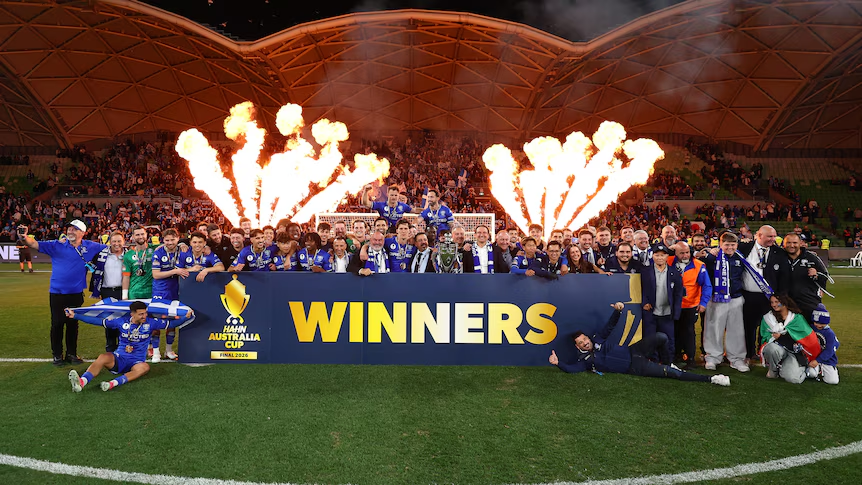
South Melbourne beat Melbourne Victory on penalties at AAMI Park on Saturday to become the first NPL club to win the Australia Cup. A record crowd of 29,911 watched it happen, a year after the club won the inaugural Australian Championship.
It would be easy to file this away as a great cup story. I think that undersells it. This could be a seismic moment for Australian club football, and the sport should treat it as one.
The Timing is a Story
This result didn’t come at a random time. The Socceroos have just reached the World Cup knockouts in a tournament that drew huge Australian television audiences, while the Matildas have qualified for the 2027 World Cup. National attention on the game has been high. The question is what the domestic game has to offer the people watching.
Until now, the answer has been narrow: the A-League, and little else. South Melbourne just widened it. A club with roots in the National Soccer League era, a loyal community and a genuine underdog story beat a modern professional heavyweight in front of nearly 30,000 people. That is exactly the kind of narrative the domestic game has struggled to manufacture.
A Pyramid Worth Building
Western United’s exit from the A-League was a setback, and nobody should pretend otherwise. But it also sharpens the question Australian football has to answer: what should the domestic game look like beyond the A-League?
With the Australian Championship bringing leading NPL clubs into a national competition, and the Australia Cup connecting every level of the game, Australian football has the building blocks of a genuine pyramid, with real pathways, real stakes and stories that can run both ways. What it needs now is the will to finish building one.
That would matter commercially, because it gives football something the other codes don’t have. A pyramid sells drama: promotion ambitions, giant-killings, clubs with a century of identity fighting their way back. South Melbourne has said it wants to return to the A-Leagues. In a genuine promotion-and-relegation pyramid, that is a storyline a broadcaster can build a season around and a sponsor can build a campaign around.
A genuine pyramid could, and I believe should, give football a unique position in the Australian sporting landscape. That only happens if the sport stops treating it as a governance exercise and starts treating it as a product.
Why Sponsors Should Pay Attention
The best-performing sponsorships rarely come from logo exposure alone. They come from authenticity and access to communities that larger properties can’t reach. Historic clubs like South Melbourne offer both: distinct local identities, multi-generational supporter bases and a story fans already believe in.
The opportunity right now is that these properties are still undervalued relative to the attention they can generate. That gap won’t last. The brands that move while the story is fresh will secure far better terms than those who arrive once the market has caught up.
Where The Opportunity Lies
Attention fades quickly. If South Melbourne and the wider game want to convert this moment into lasting value, the work starts now.
Here is where I’d be looking. The first is data: media value, social growth, new-supporter sign-ups and sponsor visibility from the cup run are the raw material of any commercial proposition, and they are easiest to capture while the attention is fresh.
The second is existing partners, who deserve to see what the win delivered for them before anyone pitches new ones.
The third is the story itself, because content, community activations and a clear narrative about where the club is heading are worth more to a sponsor than inventory alone.
Finally, broadcasters have a chance to back the pathway between the NPL and the A-League. Consistent coverage of NPL and Australia Cup football would give the audience a reason to follow the story beyond a single final.
The Risk is Complacency
A single result doesn’t guarantee sustained audiences or sponsorship revenue, and the financial sustainability of professional football remains a serious question. But the combination of a Socceroos World Cup knockout run, a Matildas side continuing to command attention and a cup win like this creates a rare opportunity. The question isn’t whether there is an opportunity. It’s whether anyone is organised enough to take it.
South Melbourne has given Australian football a glimpse of what a more compelling domestic game could look like. The challenge now is to build a structure that gives fans, clubs, broadcasters and sponsors a reason to care long after the final whistle.
F42 Consulting works with clubs, rights holders and brands to turn sporting moments into commercial outcomes. If you’d like to talk about what this moment means for your organisation, get in touch.